MOVING TECH · CONCEPTUAL CASE STUDY

Join midway.
Know your share.

A simpler way to join a group road trip: choose your pickup, agree to your share, and get a confirmed seat. The organiser sees exactly what changes for the group.

RoleProduct Design
ScenarioMid-route road trip
SurfaceMobile
Duration3 days
PROBLEM & SCOPE

Joining part of a trip needs a complete agreement

There is a gap in group trips: they assume everyone travels together, while partial joiners coordinate in chat. Pickup, cost and confirmation become separate conversations. I focused on bringing those decisions into one joining flow.

Riya joins four friends on their Bengaluru–Madikeri trip at Mysuru or Kushalnagar. She needs to know where to meet and what she owes. Ananya, the organiser, needs to review the pickup and revised split before confirming her seat.

MVP scope · One friend, one onward journey
Choose an existing pickup stop, review travel and stay costs, agree, and request a seat. Include approval, cancellation and decline states, plus pickup details and map access. Return travel, flexible stay dates, booking and payments sit outside this flow.
ASSUMPTIONS

The rules that keep the split understandable

An existing trip, a known group
Ananya has already planned the route, timings and stay. Riya joins through an invitation; trip creation and booking happen elsewhere.
Two pickups, no detour
Mysuru and Kushalnagar are planned stops. Riya reaches either pickup independently and stays for both nights; this version covers partial travel, not a shorter stay.
Travel varies; stay is fixed
Riya shares fuel and tolls only from her pickup onward. The earlier leg costs her ₹0. A separate ₹1,500 contribution covers the two-night stay.
Agreement before confirmation
Riya agrees to the estimate before sending a request. Ananya checks seat availability and confirms; only then does the new split apply.
CORE FLOWS

Three flows, including when plans change

The three flows on the Final UI page cover joining, withdrawing a request, and an organiser declining it.

Flow 1 — Main flow
Invitation → Pickup → Review & agree → Request → Organiser confirms → Seat confirmed
Flow 2 — Cancel request / Keep, withdraw, retry
Pending request → Keep request or cancel → Review pickup & try again
Flow 3 — Organiser decision / Keep reviewing or decline
Joining request → Decline sheet → Keep reviewing or decline → Joiner sees outcome
DESIGN DECISIONS

Four choices that make joining easier to judge
01
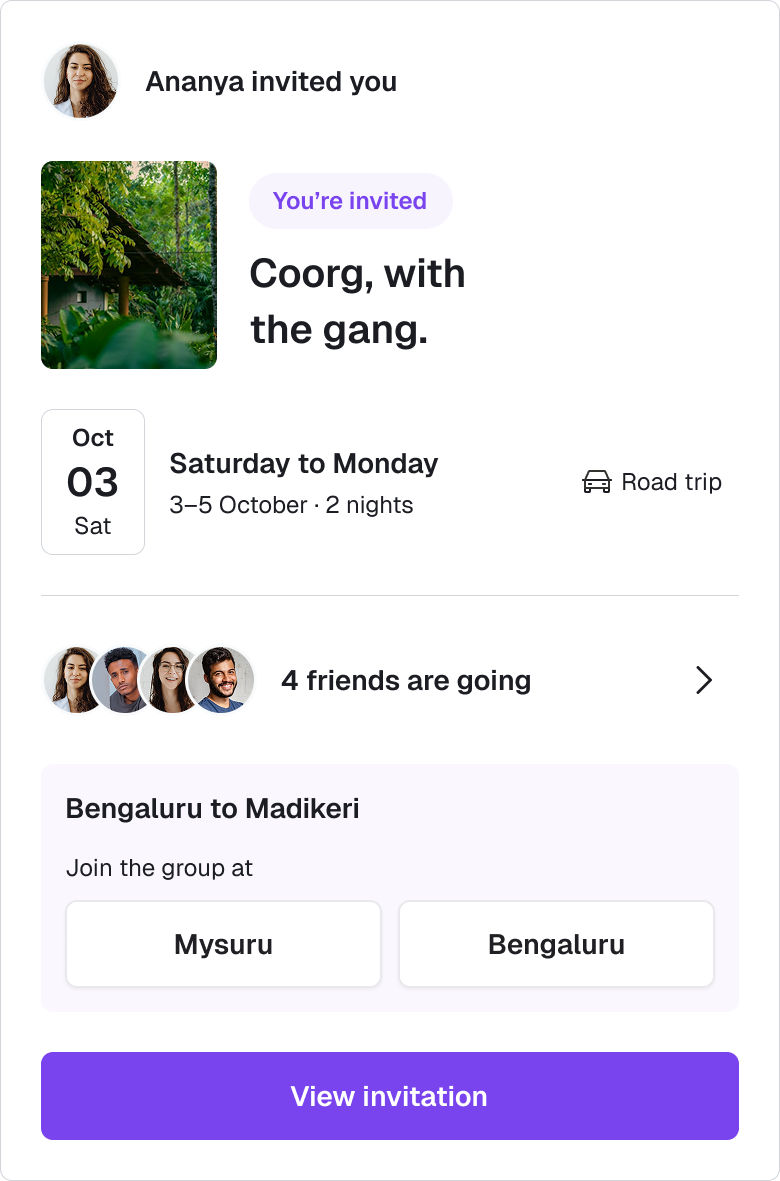
Trip card: variation 3 keeps the first choice simple
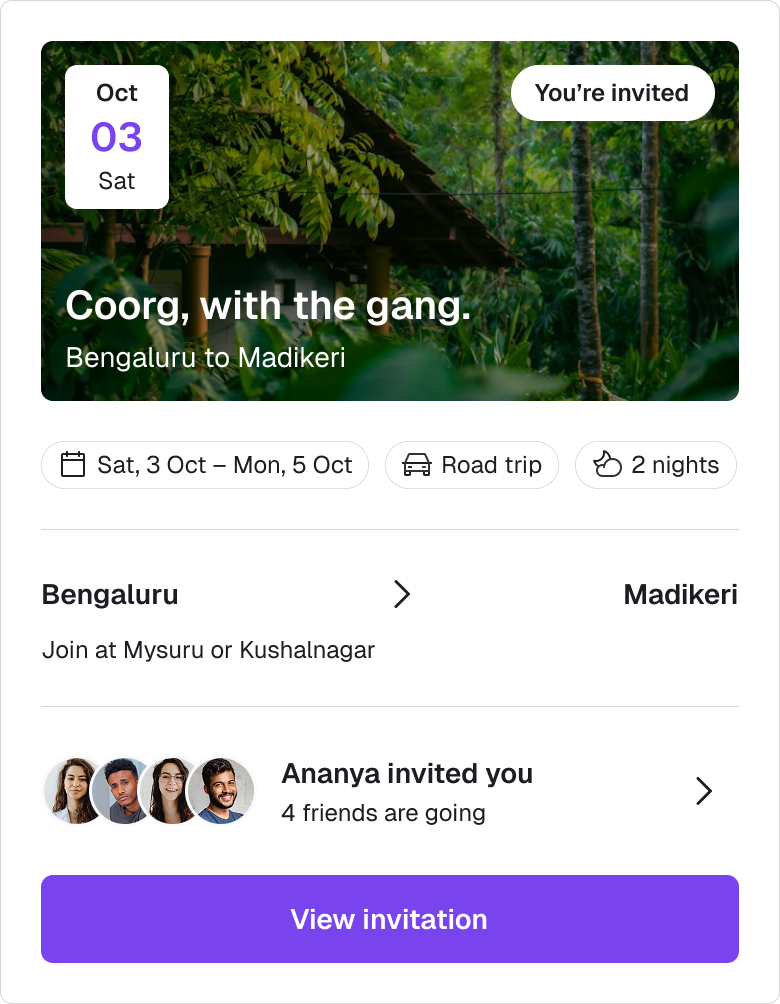
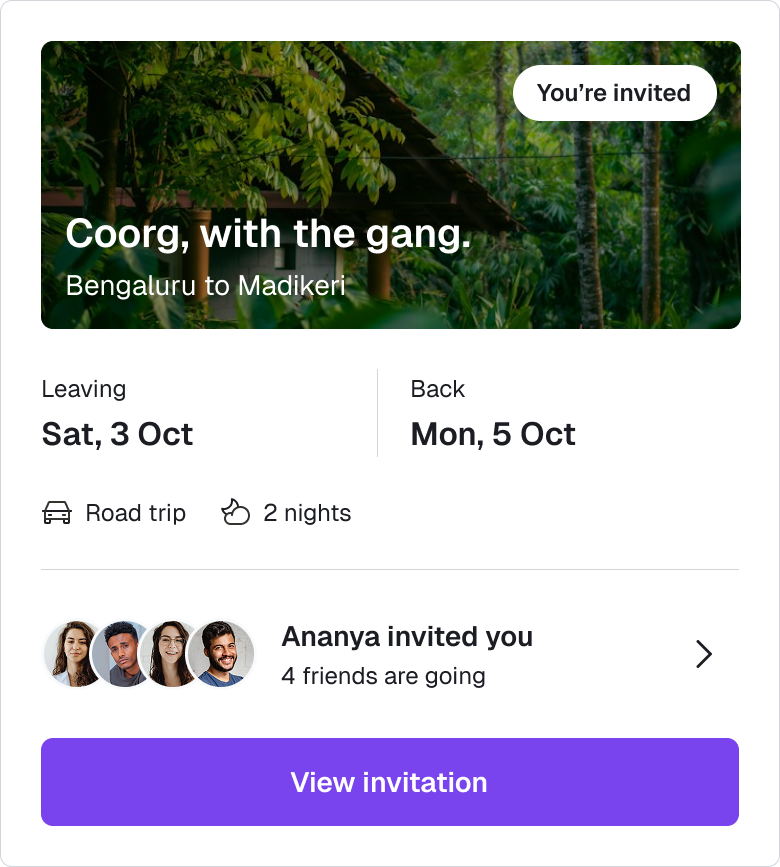
Variation 1 brought pickup controls onto the card. Variation 2 added a route summary alongside date details. I chose variation 3: clear “Leaving” and “Back” dates, the route and the group, with one invitation CTA. Pickup choices come after the friend has opened the trip.
Variation 1 · Pickup on the card
First trip card variation with pickup choices before opening the invitation.
Variation 2 · Route summary
Second trip card variation with calendar badge and inline route summary.
Variation 3 · Chosen
Chosen trip card with separate Leaving and Back dates and one View invitation button.
02
The route is one tap away in a bottom sheet
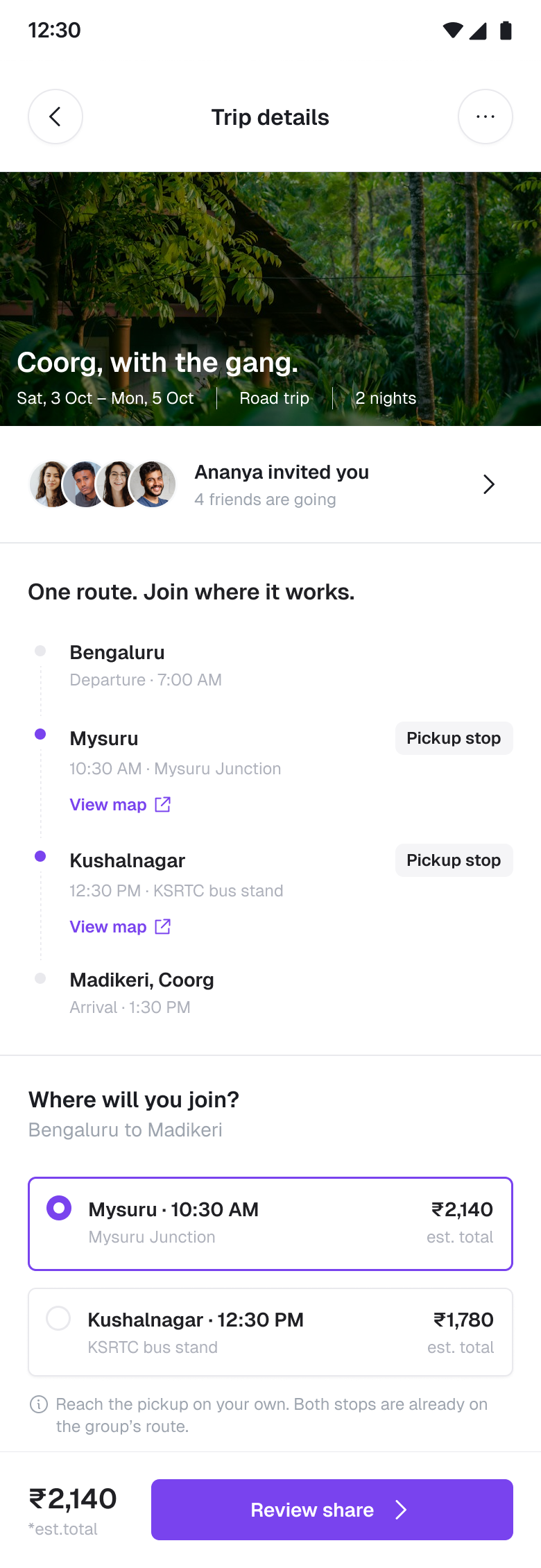
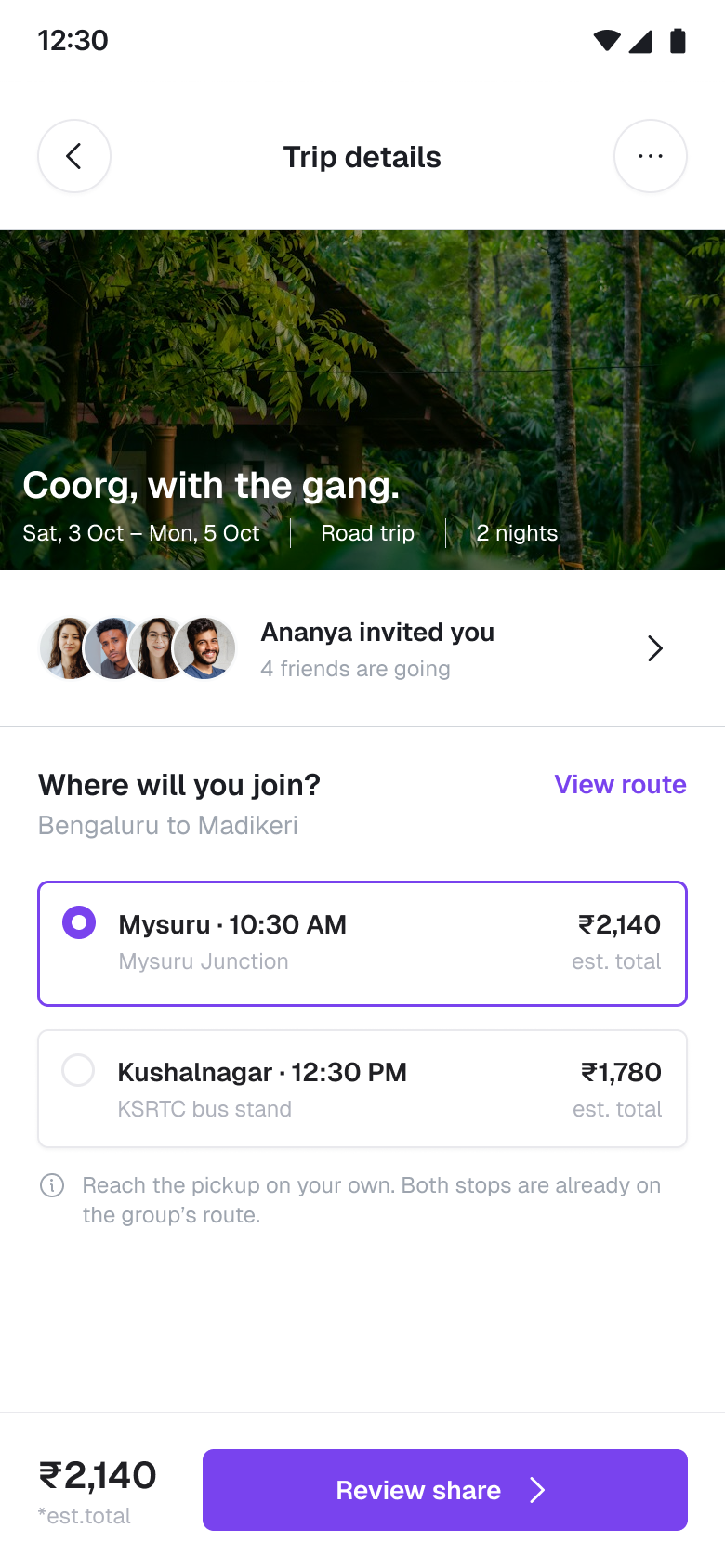
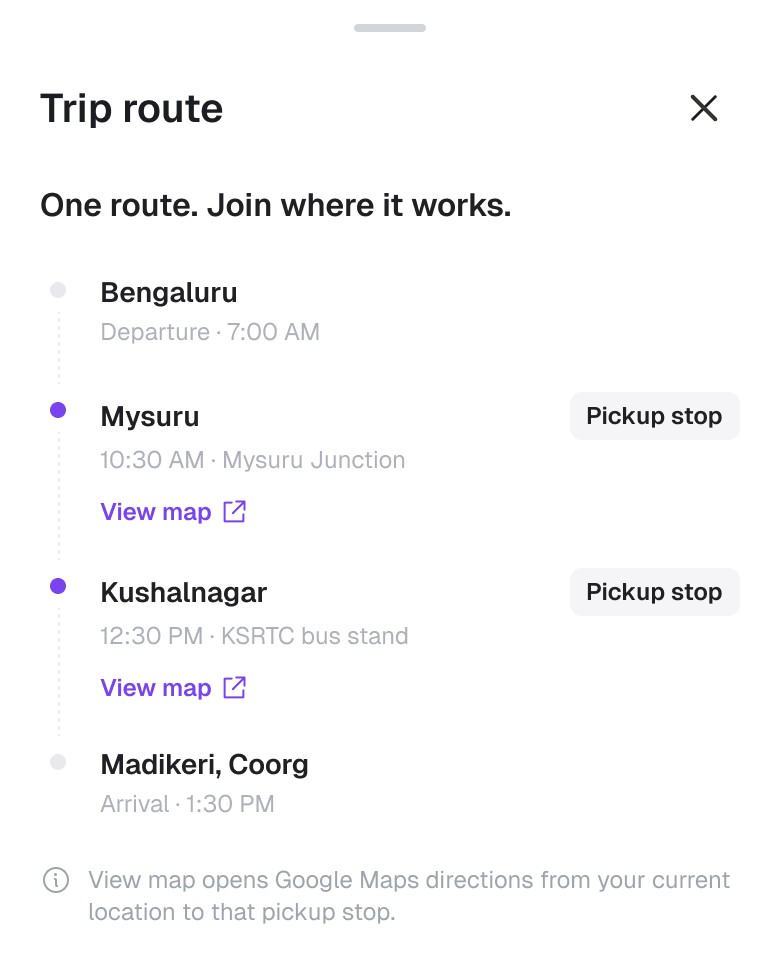
An inline itinerary lengthened the page and repeated the pickup details. The bottom sheet keeps stops, times and estimates together on the main screen, while “View route” provides the full journey when needed. Closing it returns the friend to the same decision.
Explored · Route on the page
Trip details with the full route inline below pickup selection.
Chosen · Pickup stays in focus
Chosen trip details with pickup options and a View route link.
On demand · Route bottom sheet
Trip route bottom sheet showing stops, pickup times and View map links.
03
A request starts with explicit cost agreement
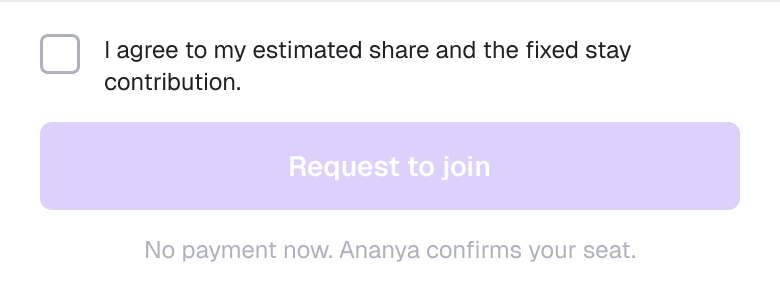
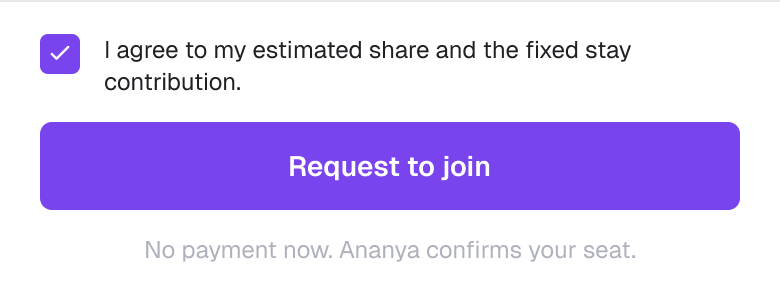
“Request to join” stays disabled until the friend ticks the agreement checkbox. Travel costs and the fixed stay contribution are visible first, so Ananya receives a request with an agreed estimate. Changing the pickup resets consent. The checkbox records agreement; no payment is taken.
Before agreement · Request disabled
Unchecked agreement checkbox with disabled Request to join button.
After agreement · Request enabled
Checked agreement checkbox with enabled Request to join button.
04
Show “₹160 less each” beside the revised split
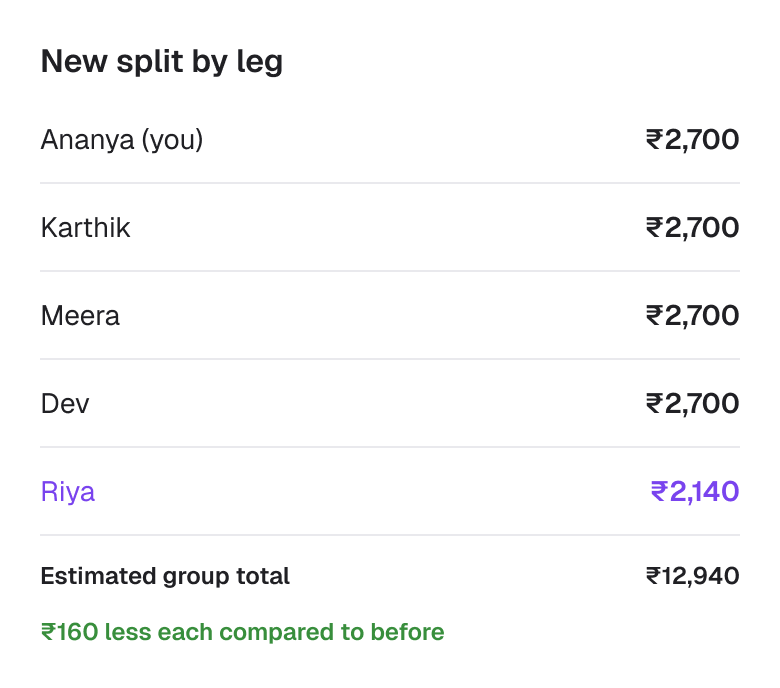
New totals alone make Ananya work out the benefit. For the Mysuru pickup, “₹160 less each compared to before” makes the saving for each existing traveller explicit. It explains what changes for the group, while the confirmation note makes clear that the new split is still conditional.
Mysuru pickup · ₹160 less each
Revised split with ₹2,700 for each existing traveller, ₹2,140 for Riya, and ₹160 less each compared to before.
FINAL DESIGN

A clear pickup, an agreed share, a confirmed seat

Try both pickup options, review the split, and switch to Ananya’s view to confirm or decline. The confirmed plan keeps the meeting point, time and map access together.

Full hi-fi UI canvas — joining, cancellation and organiser decision flows
Explore live prototype
TRADE-OFFS

The limits of a focused first version

Fixed stops limit pickup flexibility
Choice
Offer Mysuru and Kushalnagar, already on the route.
Cost
The friend must reach a listed stop, even if another location is more convenient.
Why
Protect the group’s route and timing while making two pickup options easy to compare.
Manual approval adds a wait
Choice
Confirm a seat only after the organiser reviews the request.
Cost
The friend cannot treat a submitted request as a reserved seat; a slow response can delay their plans.
Why
Capacity and group readiness need a human check. Separate pending and confirmed states keep that dependency visible.
Upfront agreement stops short of settlement
Choice
Agree to estimated travel costs and a fixed stay contribution without collecting payment.
Cost
Actual travel costs may change. Final reconciliation and renewed agreement for changes are not covered yet.
Why
Resolve the joining decision first, while keeping the estimate and fixed charge distinct.
SUCCESS METRICS

Measure confidence at each joining step

Three proposed targets cover completing a request, understanding the cost and knowing where the request stands.

≥80%

Unassisted request completion

Invited joiners choose a pickup, review the share and send a request without help.

≥90%

Correct cost understanding

Joiners explain their travel share, the excluded earlier leg and the fixed stay contribution.

≥90%

Request status clarity

Joiners correctly identify whether their seat is pending, confirmed or declined, and know what to do next.

WHAT’S NEXT

Validate the flow. Make the agreement reliable.

01
Validate both sides of the agreement
Test the finished prototype with five joiners and five organisers. Check pickup choice, cost understanding, pending versus confirmed status, and recovery from cancellation or decline. Fix observed confusion before adding features.
02
Define what happens when the plan changes
Work with product and engineering on late arrivals, full seats, unanswered requests and revised costs. Decide when requests expire and when a change needs fresh consent, then design those states.
03
Validate whether the split feels fair
Review both pickup options with real travel groups. Check whether joiners and organisers understand and accept the travel split and fixed stay contribution. Use disagreements to refine the cost rules and explanation.
04
Connect request updates to trip notifications
Notify the organiser when a request arrives and the joiner when it is approved or declined. Link each update to the current trip state, keeping pickup details and the agreed estimate consistent for both people.